
Handwork in the last step of three projects: the blue wax caps on Ticaret's Garum, the rubber-stamped labels Bulldog Studio made for Artiga wines, and Tatiana Egoshina's video mapping Ceneri di Pietra.
Among the work covered by design outlets this week, three projects have a human hand in the final step. Ticaret, a sauce maker in Munich, capped its Garum bottles in blue wax. The Spanish winery Artiga stamps each label by hand, as a family. The designer Tatiana Egoshina gathered stories from a mountain village in Italy and projected them onto cliffs in a video mapping piece called Ceneri di Pietra.
| Ticaret Garum (designed by Herburg Weiland) | November 6 | Blue wax caps and a handwritten logo |
| Artiga wines (designed by Bulldog Studio) | November 5 | Rubber-stamped labels pressed by the family |
| Ceneri di Pietra (Tatiana Egoshina) | November 5 | Research into local stories and hand-sketched symbols |
Ticaret's Garum (November 6). Garum is a fermented fish sauce with roots in ancient Roman cooking. Ticaret, a sauce maker in Munich, makes it from anchovies, koji and rice, and the article says the fermentation is by Daniel Pietsch. The packaging was designed by the studio Herburg Weiland.
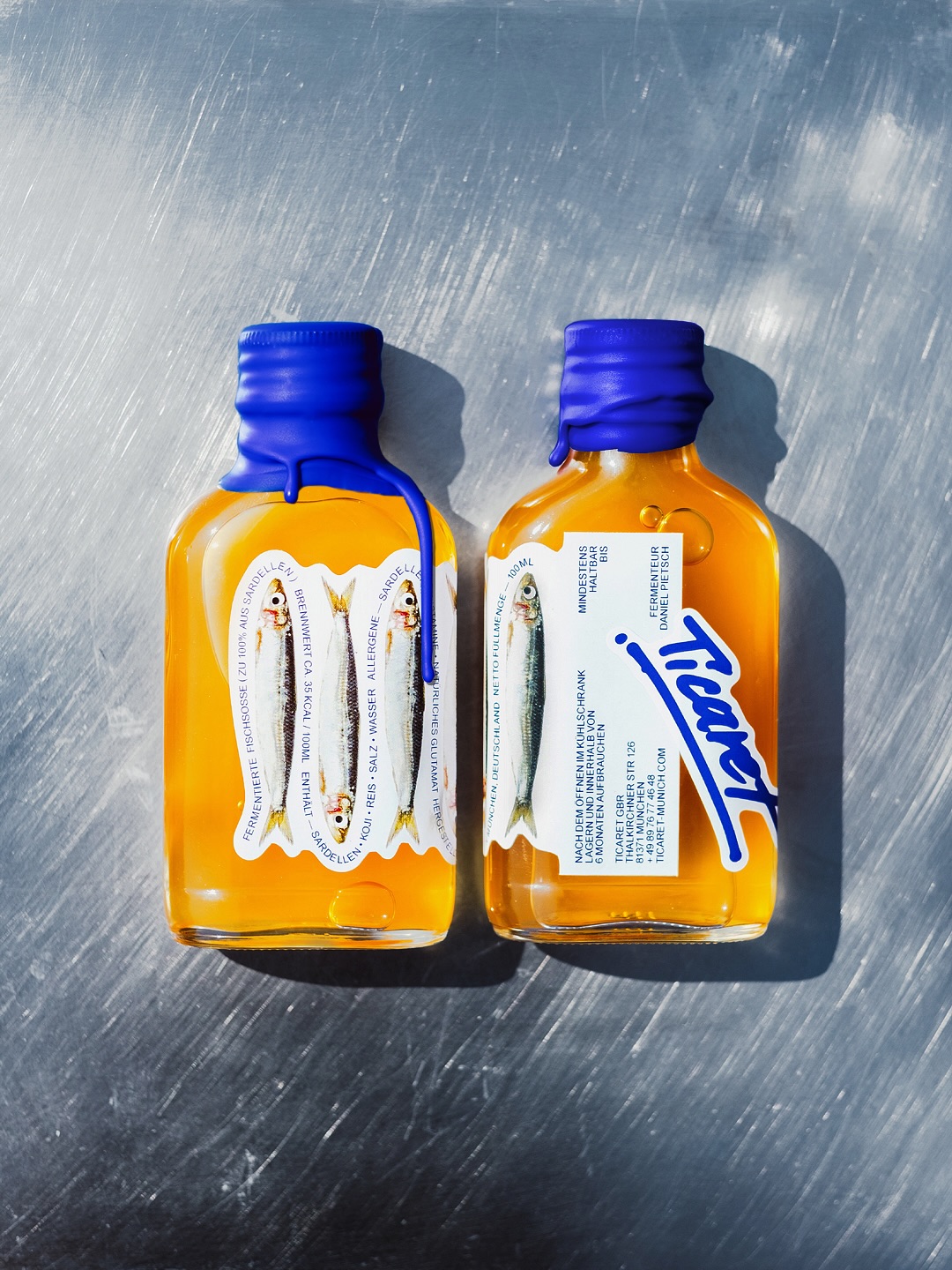
Image: DIELINE, no photographer is credited in the article
The article says the packaging departs from traditional fish sauce bottles. The cap is electric blue wax, and the white label shows three detailed sardines. Tiny blue type curves around their bodies like annotations in an old scientific specimen book. On the back is a handwritten Ticaret logo. The writer concludes that tactile details and a little visual humor make even a very traditional ingredient feel fresh.
Bulldog Studio and Artiga's stamped labels (November 5). Artiga is a winery on one tiny vineyard in DO Alella, Spain's smallest wine region, and it makes just two wines. According to the article, urban sprawl has shrunk the region to a third of its size since 1956, and no machine touches the vines. Bulldog Studio designed a set of rubber stamps so that no machine finishes the labels either.
Image: DIELINE, no photographer is credited in the article
The winegrower and his family press the stamps by hand onto each pre-printed label. The article says every bottle comes out a little different, with ink slightly heavier in one place or a name slightly crooked in another. The writer values that the label is actually handmade rather than styled to look handmade. In the photo, green and red stamp ink sits over the printed white labels.
Tatiana Egoshina's Ceneri di Pietra (November 5). The Milan-based designer Tatiana Egoshina spent a week in Castelmezzano, a tiny mountain village in southern Italy, listening to local stories. From tales told at the table of a hundred-year-old woman, about herbal healers, years of fire, witches and white dogs, she made the video mapping piece Ceneri di Pietra with the sound artist Livia Borzetti. Video mapping fits projected video to a surface that is not flat, such as a building or a landscape.
Image: Creative Boom, no photographer is credited in the article
The photo above is the article's lead image. It shows the designer in front of her poster work, not Ceneri di Pietra. The article contains no image of Ceneri di Pietra itself. The piece is a moving installation, so a still image cannot show it.
According to the article, Borzetti spent the week decoding the local dialect while Egoshina sketched symbols. The finished work is a composition of light, poetry and quadraphonic sound, projected onto cliffs of the Dolomiti Lucane in June 2026 during The Breath of Light, a rock-mapping residency run by the town and Basilicata Creativa. It won first prize at the residency. Egoshina says these are things you simply cannot Google, and calls the work the biggest canvas she has ever worked on.
The three projects put the hand in different places. Ticaret used it on the cap and the logo, Artiga on the last printing step of the label, and Egoshina on research and sketching. What they share is that the handwork is a step in how the thing is made, not a decoration added afterwards. One small thing to try: pick a single part of what you are making and finish it by hand, even if a tool could do it for you. These are cases the outlets chose to present, and nothing in these sources shows that handwork raises sales or reaction.