
Six design items, each read at the source: GOV.UK's AI content evaluation tool, Luke Wroblewski on agent feedback, new tools from Tripo and Adobe, Koto's EV brand report and Aplomb's packaging.
Six items in design today. Two are about how people check what AI produces (the UK government's GOV.UK content evaluation tool, and design systems with agent feedback), two are new tools (the 3D tool Tripo and the video editing app Adobe Premiere mobile), and two are about brands (an EV brand report and a perfume package). We opened each source and checked what it says.
| GOV.UK AI content evaluation tool | November 3 | Scores generated guidance scenario by scenario |
| Luke Wroblewski on agent design feedback | November 3 | Fixes the last misalignments with screen annotations |
| Tripo Agentic Canvas | November 2 | Joins 3D steps as nodes you can rerun |
| Adobe Premiere mobile music | November 3 | Licensed UMG and WMG tracks are coming |
| Koto EV brand report | November 3 | Looks at identity as EV features converge |
| Aplomb perfume packaging | October 29 | Turns each scent into a letter to one person |
- Design in governmentGOV.UK AI content evaluation tool (opens in a new tab)Scoring generated guidance by scenario
- LukeWDesign Feedback for AI Agents (opens in a new tab)The gap between a design system and an agent
GOV.UK's AI content evaluation tool (November 3). The GOV.UK AI team, part of the UK government's digital service, tackled how to review guidance that is generated differently for each person. The text is not generated until someone asks, there can be thousands of messages to sign off, and one good example says nothing about the next hundred. So they built a test runner for content instructions. It runs every scenario, such as having a baby, bereavement, job loss or starting a business, against a prompt in one go, scores the results automatically against a rubric, then they read the failures, change the prompts and run it again.
The criteria are concrete: are titles in -ing form, does the text address the reader as "you", is a legal requirement phrased "you must", is a deadline anchored to the life event instead of a calendar date. Mechanical criteria such as title length or whether a string contains a date are code checks, while judgement calls go to a model judge calibrated against human labels. According to the figure's description, one plan is checked against 21 rule-engine criteria and 19 model-judge criteria. Criteria are pass or fail, and the team looks at the pass rate of a single criterion across every scenario, because that points to the one prompt line to rewrite. The evals cover content design only, with accuracy checked elsewhere, and the team calls it an open experiment.
Luke Wroblewski on agent design feedback (November 3). Luke Wroblewski writes that no design system can hold every layout and feature combination a product needs, and should not try, since a bigger system brings more people and more complexity. His answer is a light feedback loop. The design system and agent instructions get about 90% of the way (earlier models managed 50 to 60%), and he then shows the agent visually where things do not line up and has it fix each one. He tried Figma comments, annotated screenshots and typing into a chat box, and that became a feature in the latest Intent release: the macOS notch lets you annotate anything on screen, and send screenshots and videos too.
Image: lukew.com
Feeding that feedback back into the design system is the logical next step, but he says today's models lack the judgment to decide what to integrate and lean toward over-documenting instead of simplifying. A designer's judgment still matters a lot, in his words.
- PR NewswireTripo Agentic Canvas (opens in a new tab)An agent that joins 3D steps as nodes
- Adobe blogPremiere mobile music (opens in a new tab)Licensed tracks from UMG and WMG
Tripo Agentic Canvas (November 2). The 3D generation company Tripo AI launched Agentic Canvas, an agent that builds 3D workflows. Each node is one operation and the connections carry outputs to the next step. Texturing, retopology, Smart UV, PBR processing, segmentation and rigging can be added as nodes. You ask the agent to generate a workflow, inspect the result and adjust nodes one by one. Workflows can be saved, duplicated and reused, and batch processing applies them across many assets.
It targets game development, 3D printing, product design and e-commerce, film, animation and visualization. This is a press release, so it is the maker's own account, and it gives no figure for how much time it saves.
Adobe Premiere mobile music (November 3). Adobe said it is working with Universal Music Group and Warner Music Group to bring fully licensed music clips into Premiere mobile. The features are coming soon: browse, search and preview trending music by artist or track, filter by genre and duration, bookmark favorites, and add up to 60 seconds of a track to a video. Music-paired templates are also planned, and finished videos can be posted to licensed social platforms.
Image: blog.adobe.com
The tracks are licensed for personal, non-commercial use only. Work that needs commercially licensed music should keep using Adobe Stock Audio, and the app is free.
- KotoKoto EV report (opens in a new tab)Brand in the Driver's Seat
- It's Nice ThatAplomb perfume packaging (opens in a new tab)Packaging made like a letter
Koto's EV brand report (November 3). The brand studio Koto published its 2026 report "Brand in the Driver's Seat". It opens by calling EV the most interesting brand problem in any category: enormous investment, real innovation, and almost no distinctiveness. To find out why, Koto asked brand leaders directly, and the report carries those interviews. One marketing director says that if a brand reduces itself to functionality, functionality is all that counts, and another interviewee describes the car turning into a commodity appliance, a fridge.
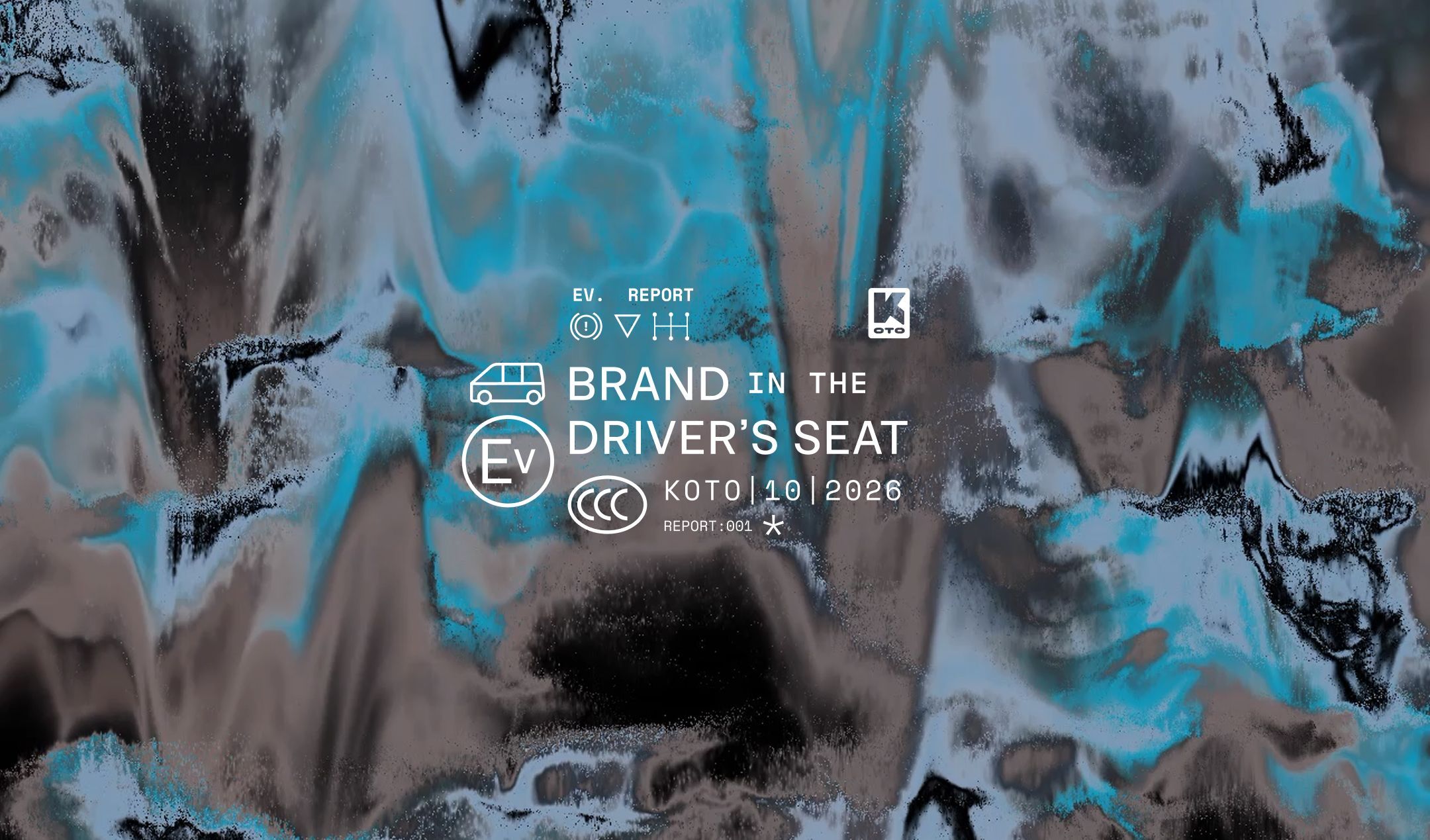
Image: Koto
The report is fully interactive, so this post only carries the introduction and interview lines that can be read at the source.
Studio Lotta Nieminen × Aplomb (October 29). For the Nordic perfume brand Aplomb, every scent was inspired by a person, and the Helsinki studio Lotta Nieminen grew the identity from the idea of each scent as a letter to someone. Letter-writing references can skew crafty, so the brief was a balance of handmade warmth and luxurious restraint. Each scent has an illustrated stamp set in a debossed frame, with a debossed perforated motif on one side like a sheet of postage stamps. Sealing wax would be too obvious as a package seal, so it went on the bottle caps instead.
The type is kept quiet in Schick Toikka's serif Edict, and the typewriter face Yorik from 205TF is the base of a secondary mark. The logo draws from circular postmarks, and its gently scattered form echoes a perfume spray, the designer says.
What ties the six together is how you check something after it is made. GOV.UK made text, Luke Wroblewski made screens and Tripo made 3D workflows something a person can look into. GOV.UK's advice to watch the pass rate of one criterion instead of an average is a habit any team checking design-system or agent output can use today. Koto and Aplomb tell the same story from the other side. As features converge, what remains is the specific story in one bottle or one car. Adobe's music is still an announcement, so the right move is to wait until it ships.
- Creating tools for scaling generated content, Design in government
- Design Feedback for AI Agents, LukeW
- Tripo AI Unveils Agentic Canvas, PR Newswire
- Premiere mobile adds music from UMG and WMG, Adobe blog
- Koto's EV trend report, Koto
- Aplomb perfume's packaging, It's Nice That